Editorial note: This article was updated on the 23rd of March 2025 to reflect technical and layout changes.
Please note that the facts cited in this article relate to 2014 data. Some of the data would likely have changed considerably since then.
By Anders Lorenzen
On the day that arguably the year’s largest sporting event begins, we bring you nine environmental and green facts about Brazil.
The run-up to the tournament has been dominated by criticism directed towards Brazil’s government, led by Prime Minister Dilma Rousseff.
A wave of protests has aimed to highlight that ordinary Brazilians will not gain anything from the World Cup.
But aside from that, what are the environmental challenges facing the world’s fifth-largest country?
Biodiversity
1) Brazil is home to the world’s largest rainforest, the Amazon, which is also said to be the most biodiverse tropical forest. The Amazon rainforest stretches over nine different countries, but most of it (60%) is in Brazil.
 |
| Aerial photo reveal the scale of deforestation. Photo credit: Planet Investigations. |
Deforestation
2) However, human impacts have brought on many risks to the rainforest, ranging from logging, cattle ranching, soy-bean, and palm oil productions, to mass dam constructions.
All these factors have resulted in the Amazon rainforest losing 600,000 square kilometres to deforestation since 1970.
There is a ray of hope, as the speed of deforestation has slowed down in the last ten years, but despite this, if current trends are to continue, by 2030 the rainforest will have reduced to 40% of its original size.
Waterways
3) The Amazon river is the largest river in the world carrying more freshwater than any other river.
It accounts for one-fifth of the world’s river flow.
Climate change
4) Climate change is having a massive impact in Brazil, which could have large economic implications.
The coffee bean is just one example. Brazil is one of the world’s largest coffee producers, and the coffee bean is already suffering the impacts of climate change.
This has been reflected in coffee prices, which are rising dramatically due to the impact drought is having on production.
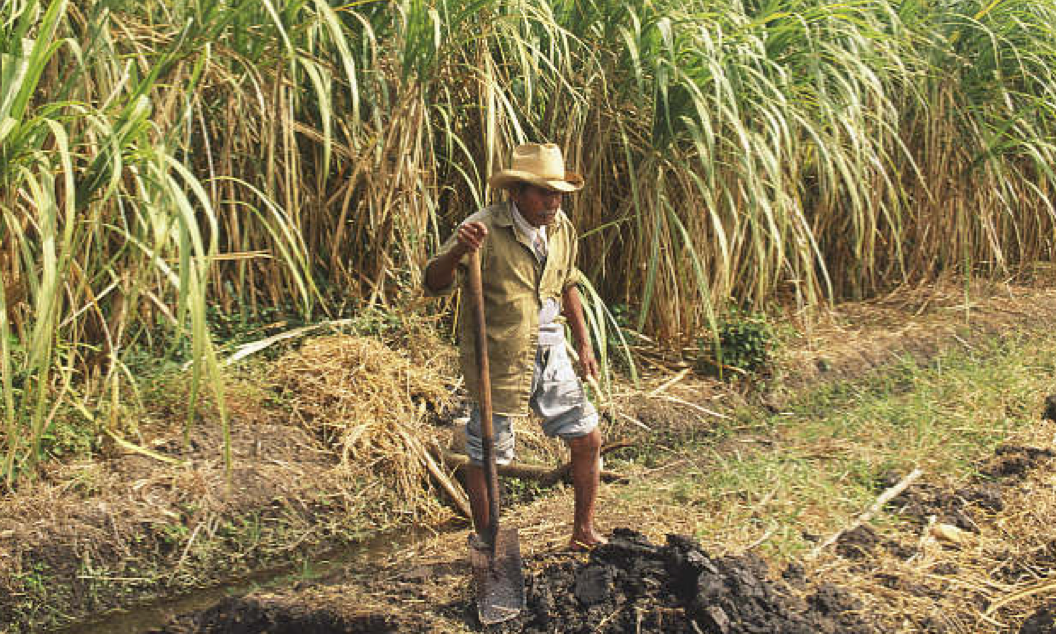 |
| A worker at a sugar cane plantation. Photo credit: Science for Brazil. |
Biofuels
5) Brazil is the world’s second-largest ethanol fuel producer.
Ethanol fuel is a biofuel produced from sugar cane, of which Brazil is one of the largest producers.
Like many other biofuels, ethanol fuel has been controversial, as it takes away land that could otherwise have been used for food production.
Environmental disasters
6) In November 2011, the US oil company Chevron leaked 416,400 litres of oil 370 km off the Brazilian coast, near the holiday destination Rio de Janeiro.
 |
| An aerial photo displaying the magnitude of the 2011 Chevron oil spill off the Brazilian coast. Photo credit: Skytruth. |
Hydropower
7) Brazil is the world’s third-largest producer of hydroelectricity. Much of this is produced from large mega dams, some in the Amazon rainforest. Their construction has demanded deforestation, and the operation has caused flooding and driven Indigenous communities away from their settlements. Therefore, it is not seen as environmentally sustainable.
Oil production
8) Brazil is the 12th largest oil producer in the world and today over 50 different companies are operating in the country; it is a net oil exporter.
They also have the second largest known shale oil resources in the world.
Renewable energy
9) Despite large potentials for both solar and wind power, very little capacity has been installed.
However, it’s estimated that 30 gigawatts (GW) of operating wind power capacity could be deployed.
It’s estimated that the potential for solar power in Brazil is among the highest in the world.
Discover more from A greener life, a greener world
Subscribe to get the latest posts sent to your email.
Categories: Brazil, The Amazon
 A greener life, a greener world
4 replies »